Horse racing is commonly known as the sport of kings, but its high financial stakes can attract crime and controversy in equal measure. Add to that scandalous headlines, unsolved mysteries, and jaw-dropping comebacks for a list of ten racehorses famous for something other than just winning.
10. Amner - The Racehorse That Killed a Suffragette
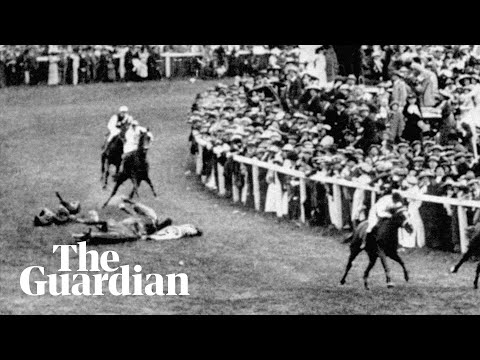
Being trampled by a one-ton racehorse travelling at around 35 miles an hour can be tragically hazardous to your health, as middle-aged suffragette Emily Davison discovered at the 1913 Epsom Derby. After being denied a degree at Oxford, Ms Davison became a political activist for women’s rights. For the 4th of June 1913, she planned a courageous stunt that went horribly wrong.
With ten racehorses rounding the final bend, Emily boldly stepped in front of Amner, a thoroughbred owned by King George V. A recent Channel 4 documentary speculated that Ms Davison was most likely trying to attach a flag to Amner’s bridle. Instead she was knocked down and died three days later.
Jockey Herbert Jones also went down with the horse and suffered concussion. The collision haunted him for the rest of his life. Fifteen years later, he honored Davison with a wreath at the funeral of suffragette leader Emmeline Pankhurst. He killed himself in 1951.
For many years, Amner’s fate remained unknown, but recently, a keen-eyed researcher discovered the final piece of the puzzle on a memorial plaque in Ontario. Three years after Ms Davison’s death the racehorse that became an embarrassment for the monarch was gifted to Canada, where he served as stud horse.
9. Copenhagen - Left the Racing World to Preside over a greater Victory
.jpg)
Foaled in 1808 and descended from former Epsom Derby winner John Bull, Copenhagen was suitably named to honor a military victory the year before. He began his racing career around 1811 and impressed punters with his stamina and powerful hindquarters, but was retired a year later after just a few wins. For the next chapter in his life, the showy chestnut stallion came into the possession of Sir Charles Steward, a soldier bound for the Napoleonic front. Here he caught the notice of Stewart's commanding officer, none other than the dashing Arthur Wellesley, the first Duke of Wellington.
Sir Charles Stewart soon became cash-strapped, and Wellington made his move, riding Copenhagen to preside over the greatest British victory of the 19th century. As befitted a high-profile warhorse, Copenhagen had a stormy temperament and famously answered a friendly pat from his appreciative owner, by attempting to kick him. answered one gesture of affection by attempting to kick his owner. After Waterloo, Copenhagen became a celebrated favorite of society ladies and lived to the ripe old of 28.
8. Thruxton - The racehorse Andrew Jackson dueled over
US president Andrew Jackson was a passionate racing enthusiast, and he did not let presidential protocol get in the way of this lucrative pastime. During his term in office, the presidential stables were simply bursting with prized thoroughbreds. To avoid scandal, he entered racehorses under the name of his nephew, Andrew Jackson Donelson for the duration of his presidency. But the most famous of Jackson’s horse racing exploits happened two decades before his term in the White House.
Jackson was eager to see how his prized Thruxton would fare against Ploughboy, the undefeated champion of the day. The matter would have been decided in a much-anticipated challenge. But then Ploughboy’s owner, Joseph Erwin canceled. Jackson was furious. A heated row between the thwarted Jackson and Mr Erwin's son-in-law, Charles Dickenson rapidly escalated to a duel, in which the future president fatally wounded his opponent. He did not esape unscathed from the encounter. A bullet from Dickenson's gun remained lodged near his heart until his death 38 years later. Thruxton, the racehorse that caused all the trouble, would later reside in the presidential stables at the White House.
7. Potoooooooo - Famous for His Unusual Name
Racehorses are notorious for their attention-grabbing names, but one 18th century racehorse took the concept of equine onomatology to the next level with his unique moniker. His owner, the Earl of Abingdon had intended to name the chestnut colt Potatoes and instructed a stable boy to paint the name on a feed bin. But the stable boy misunderstood the instruction and took down Pot-eight-O’s instead. When the earl later saw his young employee’s handiwork - literally Potoooooooo - he had a good laugh, and decided to keep the name as is.
Potooooooo notched up numerous wins and then went on to a successful second career as a stud horse, but thanks to social media, he is now mainly remembered for his unusual name. Interestingly, that was not his only resurrection. When Potoooooooon- or Pot-8-Os, to give yet another variation on his name - passed in 1800 at 27 years of age, he was buried beneath a tree at Hare Park, his last home. But in 1990, the tree marking his final resting place was uprooted and his remains were uncovered. His skeleton now stands in a place of honor in the National Horseracing Museum at Newmarket.
6. Sallie Gardner - The World's Oldest GIF
Most people don't know that cinema was born at the Palo Alto Stock Farm of railway entrepreneur Leland Stanford. What began as a hobby soon evolved into serious obsession and in his bid to improve the performance of his racehorses, Stanford recruited the eccentric photographic genius Eadweard Muybridge for an interesting experiment.
Muybridge, a landscape photographer, tweaked his shutter speed and then lined the track with cameras that were connected to trip wires. To maximize contrast on the images, he added white background screens and a layer of white dust across the racetrack. The result was a series of photographs featuring racehorse Sallie Gardner at different stages of a full gallop. Shown in succession, these snapshots simulated motion. And they settled an important question for Stanford, who had a running bet on whether horses lifted all four hooves off the ground when galloping.
An early dry run of the project had featured a harness trotter named Occident, and the successful shoot with Sallie Gardner spurred further experiments with other animals, such as camels, ostriches, donkeys, elephants, and even human athletes. Muybridge’s demonstrations later caught the attention of inventor Thomas Alfa Edison. Edison’s team later devised a peephole projector. The clip of Sallie Gardner survives even today on social media as a 145 year old GIF.
(For more detail about how Muybridge achieved this amazing feat, read my article Stanford's Horses and the Birth of Cinema in this publication)
5. Phar Lap - Who killed the New Zealand-born champion?
Right from the beginning, Phar Lap’s arrival in the Americas was fraught with tension and drama. After a stellar career in Australia, and an assassination attempt just before he won the Melbourne Cup, his owner was understandably nervous and extra security measures were already in place.
Tommy Woodcock, Phar Lap's American handler, reported seeing a suspicious person with known gang connections hanging around the stable yard in Mexico. Less than a month after the final win, Woodcock found Phar Lap in his stall in great distress. Within a few hours, the New Zealand superhorse was dead. Rumors of poison instantly circulated around the world.
The postmortem revealed Phar Lap's secret advantage. His heart, preserved and on display in Australia's National Museum, was shown to be more than 2kg heavier and considerably larger than that of the average racehorse. But the mystery surrounding his death would endure for decades. The initial autopsy indicated signs of inflammation and later tests confirmed the presence of arsenic in Phar Lap's hair follicles. But so many questions about this compelling mystery remain unanswered.
4. Haru Urara - The Lovable Loser That Became a Pop Culture Icon
In 2003, when the embattled Kochi Racetrack faced possible closure due to financial problems, a local newspaper decided to boost interest with an endearing human interest story. They introduced their readers to Haru-Urara, the hard-luck mare who had failed to score a single win after competing in nearly a hundred races. Readers were so captivated by the plucky loser horse that they showed up in droves to watch her run. Betting tickets with her name on, became a good luck charm.
The Kochi racetrack was saved and Haru Urara became a pop culture sensation. She was featured in a short, animated biopic entitled The Shining Star of Losers Everywhere, and even got immortalized in a Biffy Clyro song. Despite her dismal performance record, Haru Urara, whose name means "gentle spring" became a symbol of Japanese resilience.
3. Touch of Class - From Racehorse to Olympic gold
Although the thoroughbred filly Stillaspill was bred by a prodigy - the talented female jockey Jennifer Rowland Small - her racing performance proved so disappointing that after just six races, she was retrained as a hunter. This brought her remarkable talent for jumping to the attention of showjumper Joe Fargis.
Initially, Fargis intended to match her to one of the junior riders he coached. But there were no takers for the plucky little mare. At that point Fargis decided to work with the thoroughbred himself, renaming her Touch of Class. But then came a crushing setback. Fargis was injured. Fortunately, teammate Conrad Homfeld was willing to fill in, qualifying for the 1983 World Cup Finals with Touch of Class. The best was yet to come. In 1984, with Joe Fargis back in the saddle, Touch of Class won team and individual gold at the Olympic Games for the United States with two faultless rounds. That's not too shabby for a failed racehorse.
2. Shergar - Kidnapped by the IRA?
By the end of 1982, the Irish-bred racehorse Shergar seemed set for a glorious, off-track future. After several high-profile wins, including the 1981 Epsom Derby where he left the nearest contender a staggering 10 lengths behind, Shergar's owner/breeder, the Aga Khan was ready to retire him to stud duties and had already set up a syndicate, offering stakes in Shergar's future earnings to 34 investors.
But one cold February morning, the lucrative arrangement was shattered when a team of armed men overpowered Shergar's groom, James Fitzgerald and sped off with the racehorse to an undisclosed location. Within twenty-four hours, the owners were contacted with a ransom demand of 3 million, but soon far more disturbing interactions followed. The shareholders, who had each forked out $382,000 for their stake in the would-be sire, couldn't agree on whether to give in to the kidnappers' demands. The police were informed eight hours later, when the trail was already cold. But the next day, an anonymous caller informed Shergar's owners that the horse had met with an accident and died. What became of him, remains one of racing's most enduring mysteries. Decades later, a former IRA operative claimed that the kidnappers had to kill the panicked stallion, when they were unable to control him. No body was ever found.
1. Huaso - A 76-year-old World Record
According to his bloodline, El Huaso, formerly known as Faithful, should have enjoyed as illustrious a career as his ancestor, the former Epsom Derby winner, Persimmon. But whenever the Chilean-born colt entered the starting gate, his pent-up nervous energy always got in the way of a win. At six, he was finally retired from racing. His new owner, a cavalry officer, had great plans to train him for the dressage ring. Unfortunately, a yard injury ended this new career for the hapless thoroughbred. His handler switched to showjumping, but Huaso's lack of focus remained a problem. During one memorable training session, the horse surprised everyone by sailing across a wall of over 2 meters. This gave the Cavalry Director an idea. Could the spirited stallion be trained to jump higher than any other horse?
Two years later, Huaso cantered into a packed arena to make history. The man in the saddle was 29-year-old Colonel Alberto Larraguibel Morales. Their objective was an obstacle of 2.47 meters. Two years of training and a strong bond of trust between horse and rider paid off when Huaso flew across the jump on the third attempt. The stallion touched down, securing a place in the record books for the highest jump. His world record remains unchallenged to this day, making it one of the longest running sports records.
Bonus Horse #1 Popcorn Deelites
On the racetrack, Popcorn Deelites achieved only moderate success, winning no more than 11 races out of 58 entries. But in 2003, he won acclaim of a different variety. Along with four other equines, the thoroughbred gelding were selected to portray one of the greatest racehorses in history in a motion picture entitled Seabiscuit. Popcorn's part had been to burst through the starting gates convincingly. Upon retirement, Popcorn Deelites became a favorite resident at the Old Friends retirement facility for thoroughbreds. He died in 2022 from complications of colic.
Bonus horse #2 Snickers
Did you know that a popular chocolate bar was allegedly named after a horse? After the initial success of the Milky Way chocolate bar, Frank Mars and his wife Ethel established the Milky Way farm in Tennessee as a breeding facility for thoroughbred racehorses and Hereford cattle. A persistent legend suggests that the Snickers bar was named after one of those racehorses, a family favorite that died shortly before the bar's release. But was Snickers a racehorse? According to sources, farmland was purchased in 1930, with construction of the establishment taking place between 1931 and 1933. Milky Lane farm's first racing season was only in 1934, four years after the Snickers bar launched. While Mr and Mrs Mars may have owned and raced Snickers before this time, it is difficult to conclusively prove that Snickers had been a racehorse, as no racing record for him was independently sourced. It is possible that Snickers had been the barn name for another racehorse, or that he had been a non-racing family pet.
Sources & Further Reading:
1. Huaso
http://www.fecuestre.cl/fecuestre_V3.0/html/hitos/cont_hitos_4.html
https://sporthorse-data.com/articles/remember-thoroughbred-option-seven
https://sporthorse-data.com/pedigree/huaso
https://www.guinnessworldrecords.com/world-records/highest-jump-by-a-horse
https://www.futilitycloset.com/2020/01/08/huasos-jump/
2. Shergar
https://www.bbc.com/news/articles/ckg7pxrg5leo
https://www.racingandsports.com.au/thoroughbred/feature-race/united-kingdom/the-derby/1096
https://www.irishcentral.com/roots/history/shergar-irish-horse-kidnap
3. A Touch of Class
https://paulickreport.com/news/jennifer-rowland-small-rides-winner-in-lady-legends-for-the-cure
https://www.bloodhorse.com/horse-racing/articles/129429/small-wins-pimlicos-third-lady-legends-race
https://www.theplaidhorse.com/2019/03/13/touch-of-class-show-jumpings-great-thoroughbred-mare/
4. Haru Urara
Biffy Clyro on how life, death and Japanese horse shaped their new album
https://www.racingandsports.com.au/thoroughbred/trainer/dai-muneishi-85097
https://iol.co.za/news/eish/2004-03-12-meet-haru-urara-the-little-horse-that-could/
5. Phar Lap
https://collections.museumsvictoria.com.au/articles/1628
https://museumsvictoria.com.au/melbournemuseum/whats-on/phar-lap/
6. Sallie Gardner
https://stanfordmag.org/contents/what-you-don-t-know-about-leland-stanford-s-horses
https://penntoday.upenn.edu/news/new-way-thinking-about-motion-movement-eadweard-muybridge
https://equineink.com/2008/07/22/the-horse-in-motion-courtesy-of-eadweard-muybridge-and-occident/
7. Potoooooooo
Remembering Potoooooooo, the Racehorse with the Best Name Ever - Atlas Obscura
8. Thruxton
https://www.whitehousehistory.org/presidents-as-horsemen
https://www.presidentialpetmuseum.com/pets/truxton-andrew-jackson/
9. Copenhagen
13 – Copenhagen — The War Horse Memorial
10. Amner
Anmer, King George V’s Horse Sent in Canada: An Update
Snickers
https://archive.ph/20070610103425/http://tennesseeencyclopedia.net/imagegallery.php?EntryID=M097
https://www.tastingtable.com/1042389/the-racehorse-snickers-candy-bars-are-named-after/
https://www.turftalk.co.za/snickers-chocolate-bars-closer-to-our-souls-than-we-thought/
Popcorn Deelites
https://oldfriendsequine.org/horse/popcorn-deelites/
https://spectrumnews1.com/ky/louisville/news/2022/01/25/popcorn-deelites-passes-away-after-23-years
https://en.wikipedia.org/wiki/Popcorn_Deelites